The Three Levels of AI Maturity in Midmarket Companies
Mar 10, 2026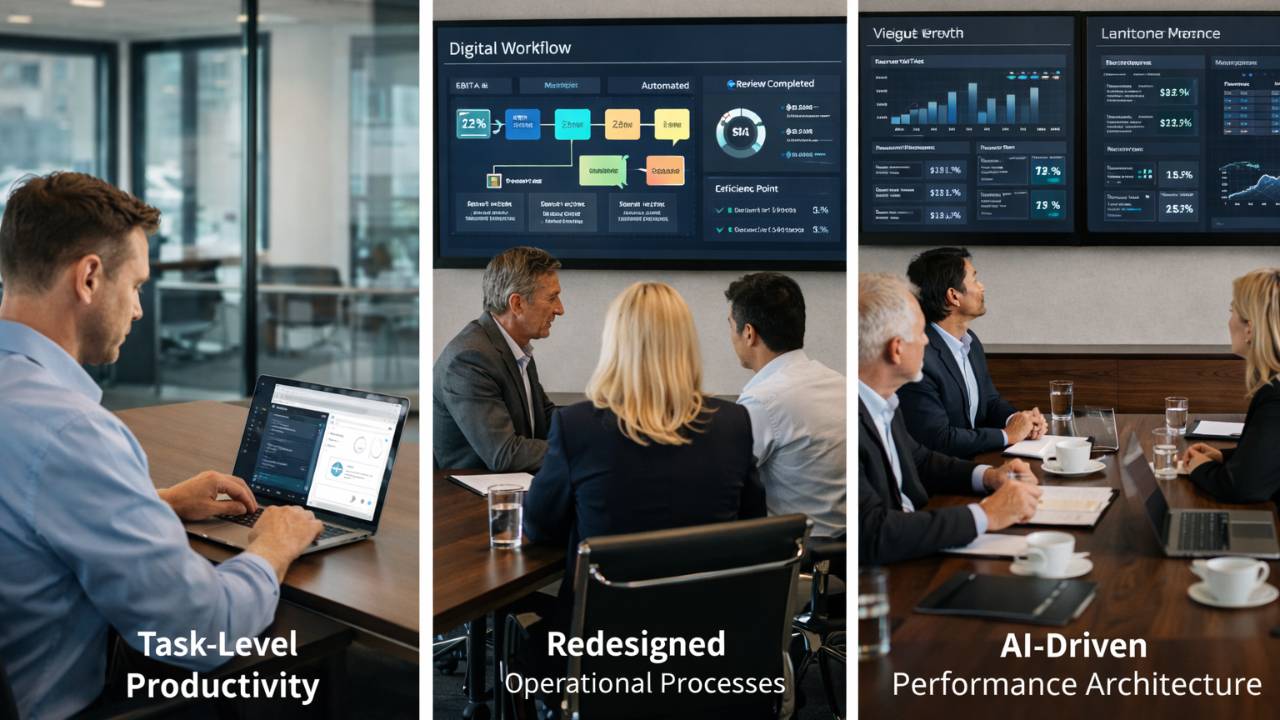
By Jon L. Iveson
Across the midmarket, artificial intelligence adoption is accelerating.
More organizations are experimenting with tools, automating workflows, and exploring how intelligence can improve operational efficiency.
However, as adoption expands, a clear pattern is beginning to emerge.
AI maturity across midmarket companies is separating into three distinct levels.
These levels are not defined by how many tools an organization uses. They are defined by how deeply intelligence is embedded into the operating model of the business.
Level One
AI Aware Operators
Level One organizations are AI aware operators.
These companies use AI tools effectively to improve productivity at the task level. Teams automate repetitive work, generate content faster, summarize information quickly, and streamline day to day operational activities.
The primary benefit at this level is speed.
Work gets done faster.
Teams handle more output.
Employees spend less time on manual tasks.
While these improvements are meaningful, the underlying structure of the business remains unchanged.
Productivity increases, but the operating model stays the same.
Level Two
Workflow Designers
Level Two organizations move beyond individual productivity improvements.
These companies begin redesigning workflows around intelligence.
Processes are restructured.
Information moves differently across teams.
AI becomes embedded inside operational pathways rather than sitting outside them as a separate tool.
The benefit at this level is efficiency.
Departments begin operating with greater coordination.
Processes require fewer steps.
Execution becomes smoother across functions.
Many companies believe they are operating at this level.
In reality, fewer organizations have fully redesigned workflows than they assume.
Level Three
Performance Architects
Level Three organizations operate very differently.
These companies function as performance architects.
Leadership teams begin by defining the financial outcomes they want the business to produce. From there, they intentionally redesign workflows, systems, and decision processes around those financial targets.
Intelligence becomes part of the infrastructure that supports those outcomes.
AI is not used simply to speed up work. It becomes embedded into how the organization produces margin, efficiency, and enterprise value.
The benefit at this level is economic performance.
Revenue per employee improves.
Margins expand.
Capital efficiency increases.
Level Three organizations are not just operating faster or more efficiently. They are producing stronger financial results.
The Subtle but Critical Difference
The difference between Level Two and Level Three is subtle but decisive.
Level Two organizations improve process speed and operational efficiency.
Level Three organizations change how enterprise economics are produced.
Most firms believe they are operating at Level Two.
Very few have crossed into Level Three.
How the Next Three Years Will Unfold
Over the next several years, these levels will evolve in predictable ways.
Level One will become baseline capability. Using AI tools effectively will simply become table stakes.
Level Two will become increasingly common as tools abstract complexity and make workflow redesign easier.
Level Three will remain scarce.
This level requires executive alignment, financial clarity, and architectural thinking about how the business produces results.
Scarcity concentrates advantage.
Organizations operating at Level Three will separate themselves not through technology adoption, but through performance design.
The Question Leadership Teams Should Be Asking
The most important question for leadership teams is not whether AI is being used somewhere inside the organization.
The question is whether intelligence has been built into the business's financial production system.
That is where the next stage of advantage will be created.
Executive Note
If your organization feels positioned between Level Two and Level Three but measurable financial lift remains elusive, there is often a structural gap between workflow redesign and performance architecture.
I will host a small executive working session later this month to close that gap and help leadership teams translate AI capabilities into measurable financial impact.
Participation will be limited to maintain the depth of discussion and executive interaction.
Stay connected with news and updates!
Join our mailing list to receive the latest news and updates from our team.
Don't worry, your information will not be shared.
We hate SPAM. We will never sell your information, for any reason.